

Driveway Gate Installation
A driveway gate is a door the size of a car, hung outdoors. The way it opens, the posts it hangs on and the ground it crosses decide most of the job before the gate itself is chosen.
Signs You Need This
- No gate yet, and you want privacy, security or a place to let the dog out.
- An old gate beyond repair, bent, rusted or rotted through.
- A gate that sags or drags on the drive however often it is adjusted.
- Rust or rot in the posts or the frame.
- A long drive on an acreage lot that needs a proper entrance.
A gate that only sags or sticks may not need replacing at all; the gate repair page covers hinges, rollers and operators.
Swing or Slide
The first choice is how the gate moves. A swing gate needs clear ground for its arc; a slide gate needs a straight run of fence beside the opening to roll into. The table compares the usual types.
More columns to the right: swipe.
| Gate type | How it moves | Space it needs | Good for |
|---|---|---|---|
| Single swing | One leaf on hinges, swinging in toward the house | A clear arc as wide as the gate, on fairly level ground | Narrower drives and side entrances |
| Double swing | Two leaves meeting in the middle | Two shorter arcs, so less depth than one wide leaf | Wide drives and a formal entrance |
| Slide on a track | Rolls sideways on wheels along a ground track | A straight run beside the opening at least as long as the gate | Sloped drives, or where there is no room for a swing |
| Cantilever slide | Rolls sideways on rollers mounted beside the opening, with no track across the drive | A straight run about half as long again as the opening | Gravel or uneven drives where a ground track would fill with grit |
What to Know Before You Call
These are the measurements and choices the estimate starts from. A rough answer to each is enough.
- Driveway width at the point where the gate will sit, wall to wall or post to post.
- Slope: whether the drive rises or falls across the opening or inside it, since a swing gate cannot open uphill into a rise.
- Post position: existing pillars or posts, or new ones, and how far back from the road.
- Power nearby: an outlet or a line close to the opening for an automatic opener.
- Automatic or manual: whether you want an operator now, later, or not at all.
Aluminum and powder-coated steel are the usual frames here; aluminum shrugs off the salt air, and steel needs its coating kept up. A solid privacy gate catches the wind like a sail in a storm, so its posts and hinges are sized for that load, while a picket gate lets the wind through.
Custom Gates
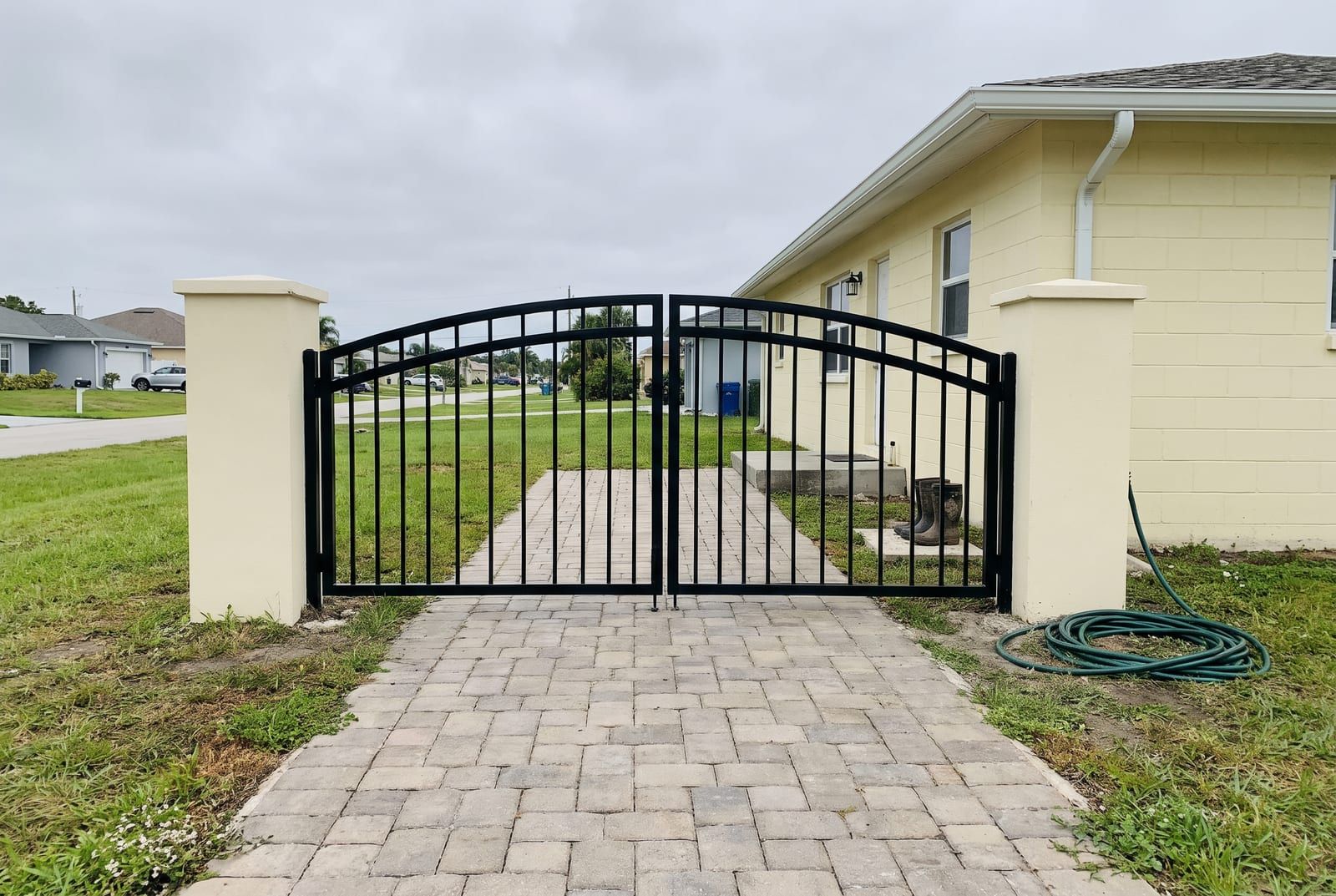
Custom gate design means the gate is drawn for the opening rather than picked from a fixed size: the height and the top line, flat or arched, the spacing of the pickets, the color, and how it lines up with the fence or the pillars on either side. A gate built to match a garage door’s color, or to sit between existing stucco pillars, is ordinary custom work.
Swing, Slide and Automatic Gates
Should I choose a swing gate or a slide gate?
A swing gate is simpler and usually the first choice on a level drive with room for its arc. A slide gate suits a sloped drive, a short drive where the arc would hit a parked car, or a wide opening on a lot with fence space beside it.
How does an automatic gate work?
An operator, a motor in an arm for swing gates or a box beside a slide gate, moves the gate when it gets a signal from a remote, a keypad or a phone. Safety devices stop or reverse it if something is in its path, and a manual release lets you open it by hand during a power cut.
Can an operator be added to a gate later?
Usually, if the gate swings or rolls freely and the posts are solid. Running a power line or a conduit while the gate is being installed makes adding one later simpler.
Do I need a permit for a new gate?
Rules depend on the gate, the fence and where it sits on the lot. Ask about it when the estimate is arranged so the paperwork, if any, is covered before the posts go in.